
The statute, provision by provision
Analyses and the provisions they discuss are open below. Expand the other statutory text as needed. Citations open highlighted sources and the complete document.
Attorneys using generative AI5 analysesDelegation · Confidential information · Accuracy verification · Correction · Disclosure
Section 6068.1 is added to the Business and Professions Code, to read:
General duties — § 6068.1(a)(1)
(a) (1) Nothing in this section shall be construed to abrogate an attorney’s duty to exercise reasonable competence and diligence in the practice of law.
Delegation(2) An attorney shall not delegate the practice of law to generative artificial intelligence.From the analysisHumans must lawyer. The prohibition on delegating the practice of law sits beside an express provision for using AI to assist. Read together, those provisions leave the lawyer responsible for deciding what advice to give, choosing the…Read analysisClose analysis
Humans must lawyer. The prohibition on delegating the practice of law sits beside an . Read together, those provisions leave the lawyer responsible for deciding what advice to give, choosing the arguments, testing the authorities, and approving the work before it reaches a client or court.
That line matters more as agents gain the ability to act. A lawyer can direct an agent to organize a record, prepare an outline, or check a citation. But there should be no robot lawyers. A system that independently selects a legal position, gives tailored advice to a client, and sends it without meaningful lawyer review is taking over the work the statute reserves to the attorney.
- Read and reason. In , the Ninth Circuit explained that checking whether a citation exists and concerns the subject is only the beginning: “A competent and diligent attorney must also read and reason.” The when subordinates performed the drafting and citation checks.
- The model cannot review its own way out of the problem. In , 21 of the opening brief’s 23 case quotations were fabricated. The court emphasized personal verification and, quoting Versant Funding LLC v. Teras Breakbulk Ocean Navigation Enterprises, LLC (S.D. Fla. May 20, 2025), said: “Attorneys cannot delegate that role to AI, computers, robots, or any other form of technology.”
- Client protection drove the legislation. Senator Tom Umberg’s and describe SB 574 as protecting clients and requiring review of AI work.
- An “AI lawyer” claim invites regulatory scrutiny. SB 574 follows federal regulatory action. The FTC’s January 14, 2025 bars unsupported claims that the service operates like a human lawyer, including by applying law to a subscriber’s particular facts or detecting legal violations on subscribers’ business websites and advising how to fix them. The order required $193,000 in monetary relief.
(3) An attorney who uses generative artificial intelligence to assist in the practice of law shall do all of the following:
Confidential information(A) Not enter confidential, personal identifying, and other nonpublic information into a generative artificial intelligence system for which access to confidential, personal identifying, or other nonpublic information the attorney inputs into the system is not restricted to the attorney and persons authorized by the attorney under obligations to protect the confidentiality of the information.From the analysisStart with access. Before uploading client material, identify who can see it, what confidentiality obligations bind them, and how the service stores and uses it. Review the contract, account settings, connected applications, and the…Read analysisClose analysis
Start with access. Before uploading client material, identify who can see it, what confidentiality obligations bind them, and how the service stores and uses it. Review the contract, account settings, connected applications, and the people with access to the workspace.
The State Bar’s 2026 guidance calls for informed client consent when the proposed use presents material confidentiality or security risks. Explain the information involved, the service, the risks, and the alternatives. Configure access to satisfy the statute. .
The account and product tier matter
| Example Services | Terms and settings to check |
|---|---|
| Perplexity Free, Pro, Max | Training-related collection is enabled by default, with an account opt-out. Confirm the live AI Data Usage / AI Data Retention setting and the consumer terms. Data collection · Settings |
| Perplexity Enterprise | Enterprise content is excluded from model training, including by third-party model providers under their agreements. Check retention separately: session attachments, My Files, Projects, and sessions have different rules. Enterprise privacy · Retention |
| Consumer Gemini Apps | Keep Activity permits model improvement and human review. Turning it off limits use of future chats, subject to feedback rules. Chats remain for 72 hours, and protection-related human review remains possible. Gemini Apps Privacy Hub |
| Gemini in Workspace | For covered services, the contract requires customer permission or instruction before customer data is used to train or fine-tune the supporting models. Review access, sharing, history, feedback, and retention controls. Workspace terms § 12.11 · Privacy controls |
Turn the review into operating rules
- Keep client content out of provider training. Use an approved account and contract with the required training restriction and confidentiality obligations.
- Get informed consent where required. Identify material confidentiality or security risks and explain them to the client before the proposed use.
- Limit what the agent can reach. Give each task the minimum documents and permissions it needs. Separate matters in search, memory, shared folders, and connected applications.
- Set retention across the workflow. Cover prompts, uploads, outputs, logs, and backups. Check what feedback submissions and support requests disclose.
- Review transmissions. Require lawyer review before the agent sends client information through an email, filing, shared link, or external tool.
A private environment in AWS
One option to avoid public models is to run selected open-weight Qwen or Kimi models in firm-hosted infrastructure. That gives the firm control over the endpoint, who can use it, and how the application stores prompts and documents. AWS Qwen deployment · Kimi K2 deployment.
Secure configuration options include private subnets and endpoints, restrictive identity permissions, encryption, controlled outbound connections, protected logs, and deletion rules for every copy. The application, document store, retrieval service, and search tools can have their own access and network rules. PrivateLink · Container network isolation. Qwen3-32B model card · Kimi K2 license.
(B) Take reasonable steps to do both of the following:
Accuracy verification(i) Verify the accuracy of generative artificial intelligence outputs, including, but not limited to, the accuracy of all case and statutory citations.From the analysisHuman verification is non-negotiable. A human, not a clanker, must read the actual case or statute, check the quotation and pin cite, confirm that the authority supports the proposition, and check its treatment.Read analysisClose analysis
Human verification is non-negotiable. A human, not a clanker, must read the actual case or statute, check the quotation and pin cite, confirm that the authority supports the proposition, and check its treatment.
There is a lot AI can do, however, to mitigate errors alongside human verification. Give one model a draft and the sources; have another model check the citations, reasoning, and omissions against those same sources. Require each flag to identify the passage and explain the mismatch.
- Put rules where the agent will use them. Use coding harnesses such as Codex and Claude Code with matter instructions and reusable skills. Tell the agent which sources control, how to capture a quotation, when to retrieve a full opinion, and how to record a missing source.
- Make checks repeatable. Extract the final paper’s citations and quoted passages into an inventory. Retrieve the source, locate the passage, compare the text, and preserve the page. Re-run affected checks after revisions.
- Show the context. Put the full source page beside the draft and highlight the precise language being relied on. The reviewer should be able to open the complete opinion, inspect the surrounding discussion, and follow the citation.
- Require a decision on each flag. Correct the paper, supply the missing source, or record why the original language is supported. Keep the responsible attorney’s review attached to the final version.
Garry Tan, of Y Combinator, made an open-source tool that can be adapted to this sort of thing. gstack shows how reusable skills can organize planning, review, testing, and an outside model’s second opinion within an existing coding harness. GBrain adds persistent, source-linked knowledge, corrections, and retrieval across agents. A legal practice can apply those patterns to preserve approved methods and matter-specific source records, with access and provider settings chosen for the information involved.
Even before SB 574, courts in the Ninth Circuit have provided guidance emphasizing the importance of human verification:
- In , counsel submitted fabricated authorities and misled the court about their source. The Ninth Circuit imposed $2,500 on each of two attorneys, suspended both from circuit practice for six months, and imposed two years of personal-verification and AI-disclosure requirements on them and their firm.
- In , counsel said he may have copied material from a Google AI Overview without realizing its source. The court held that submitting nonexistent cases itself violated Rule 11(b). It imposed a $1,000 personal sanction, client notice, an AI-ethics CLE requirement, and a State Bar referral.
- In , the opening brief was “replete with misrepresentations and fabricated case law.” The Ninth Circuit struck it and dismissed the appeal.
At BP LLP, we built a software verifier tool that can make the human verification process faster. It shows side-by-side screenshots of the brief with full source pages, exact highlights, and a review queue. Open an item, read the passage in context, add a note, and move through the authorities.
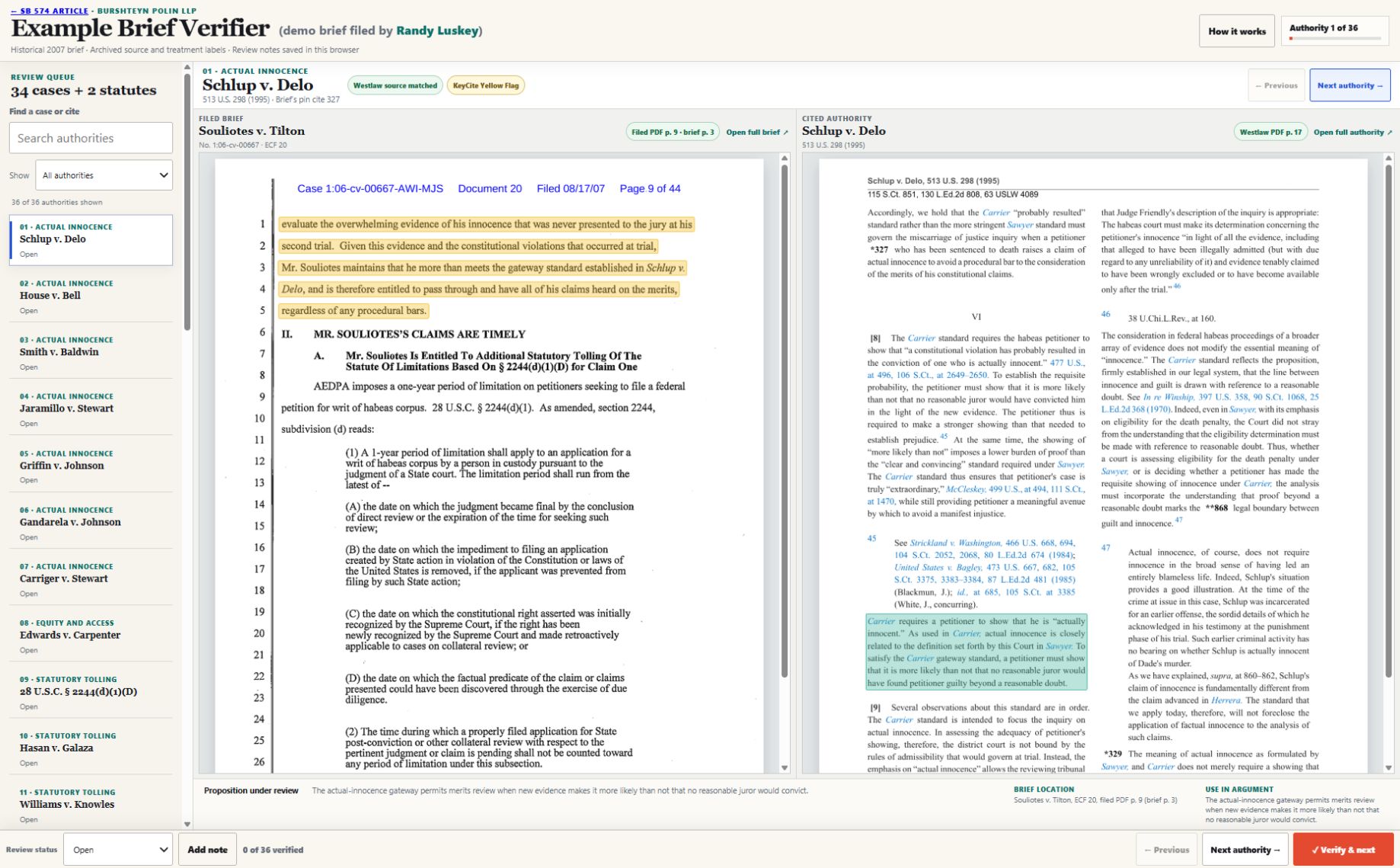 Open the Luskey verifier
Correction(ii) Correct any erroneous or hallucinated output in any material used by the attorney.From the analysisLawyers must proactively correct errors. If the error has reached the court, SB 574 requires lawyers to identify what was wrong and correct the record through the procedure appropriate to that court.Read analysisClose analysis
Lawyers must proactively correct errors. If the error has reached the court, SB 574 requires lawyers to identify what was wrong and correct the record through the procedure appropriate to that court.
A silent replacement in an internal draft leaves the filed error in place. The statutory obligation extends to erroneous output in any material the attorney uses.
In , the Ninth Circuit explained why swapping a fabricated citation for a real one was insufficient: the lawyer had to disclose the nature and source of the error to the court and opposing counsel. Make the correction candid and complete.
Disclosure(C) Disclose the use of generative artificial intelligence to the court for all documents submitted to the court and consider whether to disclose the use of generative artificial intelligence if it is used to create content provided to the public.From the analysisEvery filing must disclose AI usage. A lawyer using generative AI to assist in practice must disclose its use to the court for all documents submitted. The text reaches beyond motions and briefs to “all documents.” Lawyers should…Read analysisClose analysis
Every filing must disclose AI usage. A lawyer using generative AI to assist in practice must disclose its use to the court for all documents submitted. The text reaches beyond motions and briefs to “all documents.” Lawyers should build the disclosure into preparation and review before January 1, 2027.
Although the law supplies a statewide disclosure obligation, it’s not the limit of potential obligations. A court or judge may specify its form and impose additional requirements, including certifications, the identity of the reviewing lawyer, and preservation of prompts. Read the governing local rules and standing order alongside the statute.
Disclosure and certification do different work. Section 6068.1 requires disclosure of use. Section 128.7 governs the signing attorney’s certification and adds personal citation verification. These are distinct requirements.
Standing orders already show how this works
- Judge Rita F. Lin requires counsel to confirm the accuracy of AI research in her September 4, 2026 civil standing order. .
- Judge Eumi K. Lee requires an AI certification and describes the review required of lead trial counsel. .
- Judge Araceli Martínez-Olguín addresses certification, personal verification by designated lead trial counsel, and prompt records. The provision reaches filings, demonstratives, evidence, and oral argument. .
Public content has its own clause. When generative AI is used to create content provided to the public, the attorney must consider whether to disclose that use.
Definitions — § 6068.1(b)
(b) For purposes of this section:
(1) “Generative artificial intelligence” means an artificial intelligence system that can generate derived synthetic content, including text, images, video, and audio that emulates the structure and characteristics of the system’s training data.
(2) “Personal identifying information” includes all the following:
(A) Driver’s license numbers.
(B) Dates of birth.
(C) Social security numbers.
(D) National Crime Information and Criminal Identification and Information numbers.
(E) Addresses and phone numbers of parties, victims, witnesses, and court personnel.
(F) Medical or psychiatric information.
(G) Financial information.
(H) Account numbers.
(I) Any other content sealed by court order or deemed confidential by court rule or statute.
ADR provider certification and complaintsStatutory text
Section 6173 of the Business and Professions Code is amended to read:
(a) (1) The State Bar shall create a voluntary program to certify alternative dispute resolution firms, providers, or practitioners.
(2) A program created pursuant to paragraph (1) shall not require a firm, provider, or practitioner to be a licensee of the State Bar in order to be certified under the program.
(b) The program shall include, but shall not be limited to, all of the following:
(1) Procedures established by the State Bar for a firm, provider, or practitioner to become a certified alternative dispute resolution firm, provider, or practitioner that include, but are not limited to, a requirement that the firm, provider, or practitioner verify all of the following:
(A) The firm, provider, or practitioner requires, at a minimum, its arbitrators to comply with the Ethics Standards for Neutral Arbitrators in Contractual Arbitration as adopted by the Judicial Council pursuant to Section 1281.85 of the Code of Civil Procedure.
(B) The firm, provider, or practitioner requires, at a minimum, its mediators to comply with ethical standards that are equivalent to the Rules of Conduct for Mediators in Court-Connected Mediation Programs for General Civil Cases as provided in Rules 3.850 to 3.860, inclusive, of the California Rules of Court.
(2) Procedures for the State Bar or a professional organization approved by the State Bar to receive, investigate, and resolve any complaints that a certified firm, provider, or practitioner failed to comply with the applicable ethical standards of conduct.
(A) For mediators, those complaint procedures shall be substantially similar to the complaint procedures specified in Article 3 (commencing with Rule 3.865) of Chapter 3 of Division 8 of Title 3 of the California Rules of Court.
(B) Notwithstanding subdivision (e) of Section 6068, Chapter 2 (commencing with Section 1115) of Division 9 of the Evidence Code, the Lawyer-Client Privilege Article 3 (commencing with Section 950) of Chapter 4 of Division 8 of the Evidence Code, the Attorney Work Product doctrine as restated in Chapter 4 (commencing with Section 2018.010) of Title 4 of Part 4 of the Code of Civil Procedure, or any other law, alternative dispute resolution firms, providers, or practitioners certified by the State Bar pursuant to Section 6173, licensees of the State Bar, limited liability partnerships, or law corporations registered with the State Bar shall, pursuant to a request made as part of a procedure to address a complaint that a firm, provider, or practitioner violated applicable ethical standards, provide to the State Bar or its agents all requested information, records, or communications relevant to the conduct alleged in the complaint. This subparagraph is subject to clauses (i), (ii), and (iii).
(i) A person is not required under this subparagraph to provide information, records, or communications protected by the lawyer-client privilege or the attorney work product doctrine, without regard to which person has possession or custody of the material, unless each holder of the privilege or protection has consented in writing to its production. A person who submits a complaint under this paragraph is deemed to have consented to the production of material for which that person is the sole holder.
(ii) Information, records, or communications provided under this subparagraph shall be used solely for the receipt, investigation, and resolution of the complaint, and shall not be disclosed to any person other than the person who submitted the complaint, the firm, provider, or practitioner that is the subject of the complaint, a holder of a privilege or protection in the material, and State Bar personnel and agents assigned to the proceeding.
(iii) This subparagraph shall only apply to a mediation where one of the parties is self-represented.
(C) By providing any information, records, or communications under subparagraph (B), a person described in subparagraph (B) does not violate, waive, or extinguish, and a holder of a privilege or protection in the material does not waive or extinguish, any privilege, protection, or duty of confidentiality under subdivision (e) of Section 6068, Chapter 2 (commencing with Section 1115) of Division 9 of the Evidence Code, the Lawyer-Client Privilege under Article 3 (commencing with Section 950) of Chapter 4 of Division 8 of the Evidence Code, the Attorney Work Product doctrine as restated in Chapter 4 (commencing with Section 2018.010) of Title 4 of Part 4 of the Code of Civil Procedure, or the protections of any other rule or law.
(D) All complaint proceedings shall occur in private and be kept confidential. No confidential or privileged information, records, or communications concerning the receipt, investigation, or resolution of a complaint may be disclosed outside the course of the complaint proceeding, except as provided in subparagraph (E) or as required by an order of a court of competent jurisdiction.
(E) After a decision on a complaint, the State Bar may publicly disclose information or records concerning the complaint proceeding that do not reveal any confidential or privileged communications, including the name of a certified firm, provider, or practitioner that has been found to have violated an applicable ethical standard, any action that has been taken to remedy the violation, and the general basis on which the action was taken.
(F) Any information, records, or communications provided under this paragraph shall not be disclosed pursuant to any state law, including, but not limited to, the California Public Records Act (Division 10 (commencing with Section 7920.000) of Title 1 of the Government Code).
(3) Different levels or tiers for certification that meet both of the following requirements:
(A) Higher levels or tiers are awarded to firms, providers, or practitioners that demonstrate a higher level of commitment to accountability and consumer protection based on criteria or other standards, including, but not limited to, additional education or training, adopted by the State Bar.
(B) The levels or tiers do not reflect an assessment of the quality of a firm, provider, or practitioner.
(4) Authority for the State Bar to deny or revoke certification for a failure to meet or maintain certification standards.
(5) The professional organization approved by the State Bar pursuant to paragraph (2) shall not be a voluntary association of attorneys.
(c) (1) The State Bar may charge an alternative dispute resolution firm, provider, or practitioner seeking certification pursuant to this section a fee to cover the reasonable costs of administering the program.
(2) The fee charged pursuant to paragraph (1) may be higher in the early years of the program to reimburse the State Bar for costs related to the planning and establishment of the program, including, but not limited to, technology and preliminary staffing costs.
(3) The State Bar shall not use any moneys received from the annual license fees collected pursuant to Section 6140 or 6141 for any costs associated with this section.
(d) For purposes of this article:
(1) “Alternative dispute resolution” means mediation, arbitration, conciliation, or other nonjudicial procedure that involves a neutral party in the decisionmaking process.
(2) “Program” means the program created pursuant to subdivision (a).
Court papers, citation verification, and sanctions2 analysesPersonal citation verification · Sanctions and enforcement
Section 128.7 of the Code of Civil Procedure is amended to read:
Signatures and certifications — § 128.7(a)–(b)(1)
(a) Every pleading, petition, written notice of motion, or other similar paper shall be signed by at least one attorney of record in the attorney’s individual name, or, if the party is not represented by an attorney, shall be signed by the party. Each paper shall state the signer’s address and telephone number, if any. Except when otherwise provided by law, pleadings need not be verified or accompanied by affidavit. An unsigned paper shall be stricken unless omission of the signature is corrected promptly after being called to the attention of the attorney or party.
(b) (1) By presenting to the court, whether by signing, filing, submitting, or later advocating, a pleading, petition, written notice of motion, or other similar paper, an attorney or unrepresented party is certifying that to the best of the person’s knowledge, information, and belief, formed after an inquiry reasonable under the circumstances, all of the following conditions are met:
(A) It is not being presented primarily for an improper purpose, such as to harass or to cause unnecessary delay or needless increase in the cost of litigation.
(B) The claims, defenses, and other legal contentions therein are warranted by existing law or by a nonfrivolous argument for the extension, modification, or reversal of existing law or the establishment of new law.
(C) The allegations and other factual contentions have evidentiary support or, if specifically so identified, are likely to have evidentiary support after a reasonable opportunity for further investigation or discovery.
(D) The denials of factual contentions are warranted on the evidence or, if specifically so identified, are reasonably based on a lack of information or belief.
Personal citation verification(2) (A) A brief, pleading, motion, or any other paper filed in any court shall not contain any citations that an attorney responsible for submitting the pleading has not personally verified, including any citation provided by generative artificial intelligence.From the analysisEvery citation gets a human check. The provision covers citations from AI, an associate’s draft, an old brief, and a research platform. Assign responsibility for that review and make the sources available to the attorney responsible…Read analysisClose analysis
Every citation gets a human check. The provision covers citations from AI, an associate’s draft, an old brief, and a research platform. Assign responsibility for that review and make the sources available to the attorney responsible for submitting the paper.
The operative language is “an attorney responsible for submitting the pleading.” This means the responsible attorney must complete the personal verification.
For the workflow and cases, open accuracy verification. For the words “any court,” see where the law applies.
AI definition — § 128.7(b)(2)(B)
(B) For purposes of this paragraph, “generative artificial intelligence” means an artificial intelligence system that can generate derived synthetic content, including text, images, video, and audio that emulates the structure and characteristics of the system’s training data.
Sanctions and enforcement(c) If, after notice and a reasonable opportunity to respond, the court determines that subdivision (b) has been violated, the court may, subject to the conditions stated below, impose an appropriate sanction upon the attorneys, law firms, or parties that have violated subdivision (b) or are responsible for the violation. In determining what sanctions, if any, should be ordered, the court shall consider whether a party seeking sanctions has exercised due diligence.From the analysisThe new citation rule sits inside the existing sanctions framework. Section 128.7 requires notice and a reasonable opportunity to respond. The court decides whether subdivision (b) was violated and what sanction is appropriate.Read analysisClose analysis
The new citation rule sits inside the existing sanctions framework. Section 128.7 requires notice and a reasonable opportunity to respond. The court decides whether subdivision (b) was violated and what sanction is appropriate.
- A party’s motion. Serve a separate motion identifying the conduct. Allow the 21-day period, or the period the court prescribes, for withdrawal or appropriate correction before filing or presenting it. .
- The court’s initiative. The court describes the conduct and issues an order to show cause. The chaptered California text includes withdrawal or appropriate correction within 21 days of service of that order. .
- The remedy. Sanctions are limited to sufficient deterrence. They can include nonmonetary directions, a penalty paid to the court, and, on motion when warranted, reasonable fees and expenses caused by the violation. The court must explain the conduct and the basis for the sanction. .
- Who pays. The chaptered text bars monetary sanctions against a represented party for the new subdivision (b)(2) citation violation. Absent exceptional circumstances, a law firm shares responsibility for its lawyers’ violations. Court-initiated monetary sanctions carry the timing condition in subdivision (d)(2).
Section 128.7(g) excludes disclosures and discovery requests, responses, objections, and motions from that section. The attorney’s GenAI duties under section 6068.1 and the applicable discovery and professional rules require their own analysis.
Sanctions procedures and remaining provisions — § 128.7(c)(1)–(i)
(1) A motion for sanctions under this section shall be made separately from other motions or requests and shall describe the specific conduct alleged to violate subdivision (b). Notice of motion shall be served as provided in Section 1010, but shall not be filed with or presented to the court unless, within 21 days after service of the motion, or any other period as the court may prescribe, the challenged paper, claim, defense, contention, allegation, or denial is not withdrawn or appropriately corrected. If warranted, the court may award to the party prevailing on the motion the reasonable expenses and attorney’s fees incurred in presenting or opposing the motion. Absent exceptional circumstances, a law firm shall be held jointly responsible for violations committed by its partners, associates, and employees.
(2) On its own motion, the court may enter an order describing the specific conduct that appears to violate subdivision (b) and directing an attorney, law firm, or party to show cause why it has not violated subdivision (b), unless, within 21 days of service of the order to show cause, the challenged paper, claim, defense, contention, allegation, or denial is withdrawn or appropriately corrected.
(d) A sanction imposed for violation of subdivision (b) shall be limited to what is sufficient to deter repetition of this conduct or comparable conduct by others similarly situated. Subject to the limitations in paragraphs (1) and (2), the sanction may consist of, or include, directives of a nonmonetary nature, an order to pay a penalty into court, or, if imposed on motion and warranted for effective deterrence, an order directing payment to the movant of some or all of the reasonable attorney’s fees and other expenses incurred as a direct result of the violation.
(1) Monetary sanctions may not be awarded against a represented party for a violation of paragraph (2) of subdivision (b).
(2) Monetary sanctions may not be awarded on the court’s motion unless the court issues its order to show cause before a voluntary dismissal or settlement of the claims made by or against the party that is, or whose attorneys are, to be sanctioned.
(e) When imposing sanctions, the court shall describe the conduct determined to constitute a violation of this section and explain the basis for the sanction imposed.
(f) In addition to any award pursuant to this section for conduct described in subdivision (b), the court may assess punitive damages against the plaintiff upon a determination by the court that the plaintiff’s action was an action maintained by a person convicted of a felony against the person’s victim, or the victim’s heirs, relatives, estate, or personal representative, for injuries arising from the acts for which the person was convicted of a felony, and that the plaintiff is guilty of fraud, oppression, or malice in maintaining the action.
(g) This section shall not apply to disclosures and discovery requests, responses, objections, and motions.
(h) A motion for sanctions brought by a party or a party’s attorney primarily for an improper purpose, such as to harass or to cause unnecessary delay or needless increase in the cost of litigation, shall itself be subject to a motion for sanctions. It is the intent of the Legislature that courts shall vigorously use its sanctions authority to deter that improper conduct or comparable conduct by others similarly situated.
(i) This section shall apply to a complaint or petition filed on or after January 1, 1995, and any other pleading, written notice of motion, or other similar paper filed in that matter.
Judicial Council review1 analysisJudicial Council review
Section 180 is added to the Code of Civil Procedure, to read:
Judicial Council reviewThe Judicial Council shall publicly revisit, and revise as necessary, Standard 10.80 of the California Standards of Judicial Administration to incorporate any necessary changes to reflect the further development of generative artificial intelligence.From the analysisThe act also directs public review of the judicial-administration standard. Courts will continue developing the procedures through which AI use is disclosed, checked, and managed.Read analysisClose analysis
The act also directs public review of the judicial-administration standard. Courts will continue developing the procedures through which AI use is disclosed, checked, and managed.
Arbitrators2 analysesArbitrator decisionmaking · Information outside the record
Section 1282.1 is added to the Code of Civil Procedure, to read:
Arbitrator duties — § 1282.1(a)
(a) Nothing in this section shall be construed to abrogate an arbitrator’s duty of neutrality and duty to exercise reasonable competence and diligence.
Arbitrator decisionmaking(b) (1) An arbitrator shall not delegate any part of their decisionmaking process to any generative artificial intelligence tool.From the analysisThe arbitrator must make the decision. The prohibition covers “any part” of decisionmaking. Many lawyers have had fun running briefs through an LLM and asking who wins. But for an arbitrator, choosing the winner, weighing credibility,…Read analysisClose analysis
The arbitrator must make the decision. The prohibition covers “any part” of decisionmaking. Many lawyers have had fun running briefs through an LLM and asking who wins. But for an arbitrator, choosing the winner, weighing credibility, selecting the legal rule, and determining relief are decisions the human must make. A workflow that asks AI to select the outcome and adopts that result puts the statutory boundary squarely in issue.
Administrative assistance should be designed around that boundary: organize a record, locate a cited exhibit, or format a document while keeping evaluation and judgment with the arbitrator.
Information outside the record(2) An arbitrator shall not rely on information generated by generative artificial intelligence outside the record without making appropriate disclosures to the parties beforehand and, as far as practical, allowing the parties to comment on its use.From the analysisDisclose before relying on outside-record information. If the arbitrator intends to rely on AI-generated information outside the record, the parties receive an appropriate disclosure beforehand and, as far as practical, an opportunity…Read analysisClose analysis
Disclose before relying on outside-record information. If the arbitrator intends to rely on AI-generated information outside the record, the parties receive an appropriate disclosure beforehand and, as far as practical, an opportunity to comment.
AI definition — § 1282.1(c)
(c) For purposes of this section, “generative artificial intelligence” means an artificial intelligence system that can generate derived synthetic content, including text, images, video, and audio that emulates the structure and characteristics of the system’s training data.
Confidentiality findingsStatutory text
The Legislature finds and declares that Section 2 of this act, which amends Section 6173 of the Business and Professions Code, imposes a limitation on the public’s right of access to the meetings of public bodies or the writings of public officials and agencies within the meaning of Section 3 of Article I of the California Constitution. Pursuant to that constitutional provision, the Legislature makes the following findings to demonstrate the interest protected by this limitation and the need for protecting that interest:
In order to protect the confidentiality of privileged records and communications disclosed during an investigation conducted by the State Bar or a professional organization approved by the State Bar under Section 6173 of the Business and Professions Code, it is necessary to exempt those records and communications from disclosure.
Does SB 574 extend to federal court and out of state?
California state proceedings. The new rule becomes part of California’s statutory framework for court submissions. Read it with the full section, including the discovery exclusion in subdivision (g), and with the attorney duties in section 6068.1.
Federal proceedings. supplies the certification and sanctions framework for federal filings. The phrase “,” though, suggests broad application. It would not be surprising to see federal judges look to SB 574 for guidance.
Lawyers practicing across jurisdictions. subjects a California-admitted lawyer to California disciplinary authority regardless of where the conduct occurs. It also covers a lawyer admitted elsewhere who provides or offers legal services in California. selects the rules of the jurisdiction where the tribunal sits for conduct connected with a matter pending before it, unless that tribunal’s rules provide otherwise.
The phrase “any court” makes the new provision broad on its face. Its application in federal and out-of-state proceedings will become clearer as decisions apply the new enactment. Here, as always, better safe than sorry.
A filing workflow for January 1
- Control the drafting environment. Confirm access, confidentiality terms, training settings, retention, and the tools that can receive matter data. Obtain informed client consent where required.
- Define the AI’s task precisely with sufficient context. Give agents bounded tasks and preserve the lawyer’s judgment on advice, strategy, and representation.
- Mitigate AI errors before human review. Use a second model, source retrieval, exact quotations, and reusable instructions to surface errors.
- Reserve time and focus for human verification. The attorney responsible for submission reviews each citation against the source and the final paper.
- Disclose. Disclose AI use and satisfy certification requirements.
- Correct. Fix discovered errors and address errors already in the record.
Used responsibly, AI can dial in lawyers' precision. SB 574’s requirements codify what many of our clients and friends have considered best practices already. Hopefully it will raise the quality bar for California lawyers’ AI use. If your team uses AI, there’s no reason to wait. Best to start gearing up now.